Showing posts with label hormones. Show all posts

Sunday, August 6, 2017

Balancing Cortisol for Weight Loss and Health


Some have called it the “master” of all hormones. Others curse it for its ability to wreak havoc on our body’s fragile endocrine balance. In spite of the mixed opinions one thing is certain: cortisol is a powerful hormone necessary for life. But if its level is not optimal in your body, your health could suffer.

What is Cortisol?


The hormone cortisol is produced in the adrenal glands and is primarily responsible for regulating blood sugar, helping to metabolize fats, protein and carbohydrates and assisting in managing our stress response. We all have times of stress in our lives, and cortisol helps us to function during these times.

When the stress goes up, cortisol kicks in and delivers help. We get a quick burst of energy, our memory sharpens, our immunity increases, and our sensitivity to pain decreases. These are all important and natural functions of cortisol and ensure that we are able to weather the curve balls that life throws at us.

However, if the stress doesn’t let up, neither does the cortisol. Unfortunately, what is healthy in small bursts becomes dangerous over the long term. If you have persistent stress in your life, then you have cortisol levels that are out of balance: your body makes so much cortisol that it detrimentally affects your health. This leads to adrenal fatigue.

When you have prolonged, high levels of cortisol in your bloodstream

  • you will crave foods that are high in carbs (like cake and cookies), 
  • you will gain weight in your abdominal area (which increases your risk of heart disease and diabetes), and 
  • you will have trouble sleeping

Cortisol and the Circadian Rhythm


Our bodies produce different chemicals during the day and night that control our sleep, energy and mood. The natural rhythm of this cycle is known as the Circadian Rhythm, and cortisol is a key player.

Under normal circumstances, your body produces cortisol in amounts largely determined by the clock. Levels tend to be higher in morning—triggered by the emerging daylight--giving you a boost of energy to jumpstart your day.

As the day wears on, cortisol levels should drop, helping to prepare you for a good night’s sleep. Likewise, Melatonin (another hormone that affects your energy and sleep habits) levels should be lower in the morning but as the daylight fades, they should increase, helping you to begin relaxing and preparing for sleep.

However, if you are under constant stress or if your adrenal glands are not functioning properly, your cortisol level may not drop off during the day. Instead, it may actually rise and stay at a dangerously high level. By the time bedtime rolls around, you will not feel sleepy. You will feel “tired but wired,” and be unable to relax and fall asleep.


Reset Your Circadian Clock


If you suspect that your natural, circadian rhythm is disrupted, don’t despair. There are several things you can do to reset your clock so you can start sleeping better at night and waking up more refreshed in the morning.

Try the following tips:
  • Reduce stress. Easier said than done, I know. But many times our stress levels are correlated to our response to stressful situations. Learning how to cope with stress more effectively may be all it takes to balance your cortisol.
  • Be consistent. Going to bed and getting at the same time each day will help to regulate your circadian rhythm. Practice this habit to slowly coax your body into a schedule.
  • Use light wisely. Since your circadian rhythm is partially controlled by light, darken your room well when you go to bed, and flood it with light when it is time to get up. Try using a full spectrum light in the mornings.
  • Avoid naps. If your circadian clock is off, you may find that you get very sleepy in the afternoon. However, taking a nap may make it more difficult to fall asleep at night. Try to resist naps.
  • Eat most of your calories early. If you can eat the bulk of your daily calories earlier in the day as opposed to later in the day, you may find that you can recalibrate your circadian rhythms more easily.

Tuesday, May 30, 2017

How Hormones Affect Your Energy and Weight


Are willpower and self-control the real solution to low energy and high weight?

Maybe not.  It might be your powerful hormones.

And we’re not just talking about sex hormones here; we’re talking about the hormones that directly affect your blood sugar, metabolism, and appetite. Things that control your energy and weight.

Let’s go over a few of the critical links between your hormones, and how they affect your energy and weight. The links may be stronger than you think.

What are hormones?


Having healthy, happy hormones is all around the “health waves” these days.

And for good reason! Your hormones are part of the master control system of your entire body.
Hormones are compounds made by one part of the body that are used to communicate with another part. For example, insulin is made in the pancreas. When your blood sugar gets too high, insulin is released into the bloodstream. Then, it goes to your muscles and other cells to tell them to absorb that sugar out of the blood (and if there is still too much blood sugar, it signals to store it as fat).

Your hormones control not only your blood sugar, but also your metabolism and appetite (plus a host of other things). And you probably know that having healthy blood sugar, metabolism and appetite is a foundation for your optimal energy and weight.

So, how can your hormones get out of whack to zap your energy and pile up the pounds?

Common Hormonal Imbalances


In optimal health, your hormones would work great, and you’d have ample energy and be a good healthy weight.

But often there are problems with this whole setup. One common issue is that there may be too much or too little hormone released to have the desired effect. This is known as hypo- or hyper- “hormone” (i.e. hypo- or hyperthyroidism).

Another common issue is that, even if the right amount of hormone is released, the cells they communicate with can start ignoring them. This is known as hormone “resistance” (i.e. insulin resistance).

As you can imagine, if your hormones have such critical jobs, including controlling blood sugar, metabolism and appetite, they can cause issues with your energy and weight.

Hormones & Energy


Your metabolism is key for controlling your energy. Metabolism itself is basically how much energy (calories) you burn. One of the main players of this is...you guessed it! Your thyroid hormones.

Your thyroid releases hormones that affect the metabolism of all the cells in your body. If it’s too low and your metabolism goes down (hypothyroid), you may feel cold, hungry and tired. If it’s too high and your metabolism is too fast (hyperthyroid), you may feel hot, jittery and lose weight.

What you want is an ideal metabolism, ideal energy use, ideal temperature, and an ideal weight. Your thyroid hormones are the master controller here.

Hormones & Weight


Your weight may be controlled by hormones more than you think! Insulin controls your blood sugar, and whether that sugar is going to be stored as fat or not. And when your blood sugar is too low, you may start craving sugar and carbs.

You also have hormones that control your appetite! How hungry and how full you feel are controlled by the hormones ghrelin & leptin. When those get out of whack, you may find yourself wanting to eat because your body thinks you’re hungry and not satisfied...even if that’s not true.

And craving food (especially sugary ones) and not feeling full are going to be huge drives for you to eat more. Even if your body doesn’t truly need it, the hormonal signals tell you that you do.
And don’t forget that stress hormone cortisol. When it’s too high for too long, it tells your body to store fat. And not just any fat - belly fat!

What You Can Do


Your body is very complex and uses hormones to control a substantial number of functions. They control your blood sugar, metabolism, and appetite, among others. And these directly affect how much energy you feel, how much you weigh, and even where your body fat is stored.


Here are a few “hormone stabilizing” tips that might help you with your energy and weight:
  • Get regular exercise to use up excess blood sugar before your insulin has your body store it as fat
  • Try stress-relieving activities like deep breathing, meditation or even coloring to reduce your (belly-fat inducing) cortisol
  • Support your thyroid with iodine-containing sea vegetables, fish, legumes, or even an egg
  • Balance your blood sugar with extra fiber from raspberries, avocados, or flax seeds
  • Reduce blood sugar spikes by replacing your juice or soda with fruit-infused water
If you need some support with your energy levels and/or weight, contact me (your wellness coach) for a free strategy session to see how I can help you.


REFERENCES

http://www.precisionnutrition.com/fast-weight-loss-changes-hunger-hormones
http://www.precisionnutrition.com/all-about-thyroid
https://authoritynutrition.com/9-fixes-for-weight-hormones/

Monday, October 31, 2016

The Power of Neurotransmitters


In the case described last week, we saw how releases of dopamine, epinephrine and cortisol among other neurotransmitters could result in the fight or flight response.
But something very similar, albeit much milder also happens when you experience chronic stress. Chronic stress is the kind of stress that ‘doesn’t go away’. This is not a lion but rather an impending deadline at work, wedding planning, property investment, debt, relationship problems, etc.
This triggers a very similar stress response, which results in continued changes in your body such as suppressed immune function and digestion, a certain amount of tunnel vision, dread and anxiety etc. So when you’re stressed for long periods, this negatively affects your ability to relax and to enjoy any experiences – but it also impacts negatively on your health in more ways than you might immediately expect.
Dopamine makes us more driven and focused for instance but only on the thing that is causing the stress. This reduces activity across our brain so that we are more tightly focused on specific thoughts, emotions, ideas and inputs. That’s why ‘eustress’ can actually be a good thing and make you more likely to revise for an exam. But it has also been shown in studies to make us less creative because we’re less able to let our mind explore different, diverse ideas. Likewise, stress also makes it hard for us to focus on anything other than that thing that has our attention.
What’s more, is that stress can seriously undermine your ability to impress or influence others. That’s because stress is a sign that you’re nervous or afraid. If you give of these signs in front of a competitor, then it makes you appear to be less confident and thereby sends the signal that they must be the alpha to your beta. Likewise, if you are anxious when approaching a potential mate, it suggests on an unconscious level that they must be a better potential mate than you – that they are out of your league or at least that you perceive that to be the case!
As you can see then the ability to control your stress response can be a fantastic asset and help you to focus more when you need to, to run faster and to fight harder – or just to appear completely confident and in control in stressful situations.

More Neurotransmitters and What They Do

Conversely, other neurotransmitters can be released in response to pleasure, exercise, sunlight, tiredness, darkness, excitement and more. And these all affect our mood and our ability to focus in other ways.

  • Serotonin is the neurotransmitter that we think of as the ‘happiness hormone’. This is what makes us feel content and happy and it also has a range of other roles such as suppressing pain and decreasing appetite by stimulating the production of leptin. 
  • Melatonin is the neurotransmitter that makes us sleepy! 
  • GABA is an inhibitory neurotransmitter that reduces activity in the brain and can thereby suppress stress and further encourage sleep. 
  • Dopamine is essentially a neurotransmitter that is related to goal-oriented behavior. It makes us more focussed and increases memory among other things. 
  • Acetylcholine is one of the principle excitatory neurotransmitters and also plays an important role in memory. 
  • Nitric Oxide is a vasodilator and helps get more blood to the brain and muscles. It also activates neurons that aren’t directly connected and thus has an important role in helping us to wake up. 
  • Testosterone is the ‘male hormone’ that is linked to aggressive thoughts and behaviors as well as drive and confidence. 
  • Estrogen is the female hormone and can have a big impact on mood. 
  • Cortisol is the ‘stress hormone’ and makes us more alert while creating feelings of dread. It’s also linked with appetite, this time making us hungrier via another hormone/neurotransmitter called ghrelin. 
  • Substance P is the neurotransmitter related to the transmission of pain. It also happens to be linked to anger according to some recent research. 
  • Oxytocin, often called the ‘love hormone’, makes us more agreeable and creates feelings of loving protection and bonding. 
  • Glutamate is another of the most abundant excitatory neurotransmitters and exists in vast quantities compared to any other neurotransmitter. 
  • Anandamide is the ‘bliss’ neurotransmitter and also appears to stimulate creative thinking.
Once again, these neurotransmitters are released in response to our experiences and thoughts. When a mother sees her child, her brain floods with oxytocin which makes her more likely to bond with the child and feel the need to connect.
When you go on a rollercoaster, your body produces epinephrine and anandamide. When you have just had a great day out, you will be filled with serotonin and feel happy and positive.
In short, your happiness, productivity, creativity, attractiveness, relationships and much more are all responsible for different quantities of these various neurotransmitters.

Neurotransmitters for Incredible Abilities

Certain ‘states’ can be triggered via the release of specific neurotransmitters and this can be incredibly desirable/positive in some cases.

One example is the much-studied ‘flow state’. A flow state is a term for that moment when everything seems to fall into place and you are able to perform at your very best. This results in absolute focus, heightened reactions, improved problem solving and more. It happens when you’re snowboarding for instance and the world seems to suddenly slow down, allowing you to pull off incredible moves with expert timing. It also happens when you’re so lost in your work that you forget to the toilet or even look up from the computer. And it happens when you talk to a friend all night without realizing how long the conversation has been going.
In short, this experience is what total, creative focus feels like. And chemically, it is very similar to the fight or flight response but minus the sensation of fear or dread that normally comes from that. Instead, there seems to be a release of anandamide, which enhances creative problem solving while creating that sense of exhilaration that is so addictive to adrenaline junkies. At the same time, brain scans show that the prefrontal cortex – the part associated with planning and self-doubt – appears to shut down. This is what removes our sense of time passing and allows us to stay completely fixed on the moment. It’s known as ‘temporo-hypofrontality’.
It is thought that all major athletic records were set by flow states and that most highly successful start-ups get to where they get to thanks to flow states. So imagine if you could trigger a flow state at will and thereby achieve complete focus and perfect problem solving!

The opposite of this state is what’s known as the ‘default mode network’. This is a network of brain structures that light up when we are completely lost in thought, often while our bodies carry out mundane tasks like showering. This is what allows us to explore diverse regions of our brains and find new connections between ideas – and it’s what is believed to have helped Einstein dream up special relativity while working at the patent office.
The ‘flashbulb memory’ meanwhile shows us how our brains can be capable of laying down much clearer memories during times of extreme shock, such as the moment you heard about 9/11. Likewise, ‘hysterical strength’ shows how a strong enough fight or flight response can actually increase muscle fiber recruitment to the point where women have been able to lift cars off of their children trapped underneath.
One underground movement that is interested in the idea of using neurotransmitters to accomplish more is the ‘nootropics’ movement. Nootropics are ‘smart drugs’ which tend to work by blocking certain neurotransmitters and encouraging the production of others. These can work like the film ‘Limitless’ but on a much less powerful scale – slightly increasing memory, focus or even confidence.
The problem with nootropics is that they often come with side effects, haven’t been tested in the long term and generally make it harder for us to switch mental state as we need to. It’s no good being highly focused if it means your creativity will be suppressed!
Luckily, there are other ways to encourage the production of the correct neurotransmitters to invite the mental states we want.

Next week we'll look at how healthy eating and sleep help to improve our mental health.

Monday, October 24, 2016

Some Basic Psychology


What most of us aren’t aware of is just how much of a slave we typically are to our biology – and especially when it comes to neuroscience.
We have the illusion of self-control. That is to say that we feel like we choose what we do and we choose how we feel. If we’re angry, it’s because of some injustice – we’ve thought about the situation and decided that anger is the correct response.

If you’re happy, it’s because all is well with the world and you’re content.

We then take all this information and decide what we want to do next and how we’re going to perform at that activity.
But the reality is that we are not in charge of our brains. Rather, our brains are in charge of us. And they’re largely controlled by our bodies and our situations too. Unless we understand the workings of our brain and we’re able to take conscious control over the processes that dictate our moods, our motivations and more, then we are destined to remain at the whim of certain chemicals – and completely oblivious to that fact.

Okay, so let’s go deep right off the bat. Who are ‘you’? What makes you, you?


The answer is your brain to a large extent. And your brain in turn is made up of billions of neurons – small cells that have tendril-like extensions reaching out and into the different corners of your skull. These neurons can be created, destroyed or changed via our experiences and they represent all kinds of things including memories, sights, smells, thoughts and ‘commands’ to move our body.
When an electrical impulse moves through a neuron, this means it is ‘firing’ and thus we experience whatever correlates with that firing. If you open up someone’s skull and use an electrode to stimulate individual neurons, then one might make someone see a point of red light, one might make someone move their arm and another might make them remember their Mother. 
These neurons are all interconnected and the more often two neurons fire at once, the more connected they become. Thus, when one neurons fires, it is likely that others around it will fire depending on the strength of the firing (called an ‘action potential), other activity in the area and the strength of the connection. Some ‘clusters’ of neurons form the major brain structures like the occipital lobe, motor cortex or hippocampus which are responsible for particular behaviors. Other neurons reach from one end of the brain all the way to the other!
Already you can see how your brain is not always entirely under your control. If you see something specific, then this will cause certain neurons to fire based on your memories and understanding of that object. But it might also cause surrounding neurons to fire, depending on the associations you’ve formed during that life-time.
And when certain neurons fire, they cause particular emotions. That’s because neurons communicate across synapses – small gaps between the end of one neuron (the axon – which is like a tail) and the dendrites (like arms) of another.


At the end of each axon is the synaptic knob, which is filled with chemicals called neurotransmitters, held inside ‘neuro vesicles’. When the synapse fires, it causes these neurotransmitters to be released and that then alters the behavior of the transmission and the surrounding cells. Some neurotransmitters are ‘excitatory’ and make other neurons more likely to fire. Others are ‘inhibitory’ and make them less likely to fire – and more suppressed.
Others have more complex roles. Some for example will make you more likely to remember something, while others will make you feel happy or sad. This is what controls the way you ‘feel’ about certain experiences.
Neurotransmitters are linked closely with hormones too. Some hormones act like neurotransmitters while some neurotransmitters can act like hormones. Essentially, hormones are longer lasting and generally produced in the body, while neurotransmitters have shorter-lasting effects and are produced in the brain. Even hormones produced in the body though are largely triggered by the pituitary gland, which is located in the brain. 
 

See a lion for instance and your brain will sit up and take notice owing to the associations you form with that image. Relevant neurons will fire and because those neurons are coded with danger, they will release a number of neurotransmitters like dopamine and cortisol to increase activity and say that something important is happening. This increased activity causes more of the brain to light up and areas around the hypothalamus will then begin to trigger activity in the pituitary gland, producing adrenocorticotropic hormone. The adrenal gland will also be triggered at this point, releasing the hormone epinephrine, which is essentially a form of adrenaline. This is then what causes changes in the sympathetic nervous system.
This triggers physiological changes, including:
  • The acceleration of the heart and lungs
  • Vasoconstriction (thinning of the blood vessels) 
  • Dilation of the blood vessels leading to muscles
  • Dilation of the pupils
  • Sense of dread/anxiety
  • Tunnel vision
  • Thickening of the blood to encourage clotting after injury
  • Pain reduction
  • Contraction of the muscles
  • Shaking
  • Suppression of digestion and immune function

Essentially, the body now directs all blood, oxygen, nutrients and resources to the muscles and the brain, in order to aid in combat, escape or other physical activity.
All this is involuntary and all of this is controlled entirely by automatic responses throughout your body. And it completely changes the way you now think and the way your body operates. It changes the way people see you and it drastically effects the way you perceive everything that happens subsequently.
But it’s not just during times of high stress that you see such uncontrolled changes throughout your body. And there are many complex interactions of chemicals and hormones going on inside your body all the time…

Next week we'll dive further into neurotransmitters and how they interact with our bodies.

Wednesday, March 25, 2015

GoReIn2015 Q1 Update


I'm up a little this week but TOM is in town so it's to be expected.  Two weeks until I have my next official weigh in!

Week of Workouts

This week was ALL Kelly Coffey-Meyer's 30 Minutes to Fitness workouts.

Thursday I did Muscle Definition Workout 1.

Friday was the Train Like a Contender Conditioning workout.

Saturday I did the Muscle Definition Shoulders, Biceps, & Triceps pre-mix.


Monday was the Circuit Burn Total Circuit Burn Mix.

Yesterday was more Muscle Definition with the Back & Chest pre-mix, which I attempted the second round on the stability ball.

Today was the Circuit Burn Boxing & Legs pre-mix.

My First Race

Course Map found at http://englewoodcdc.com/race/

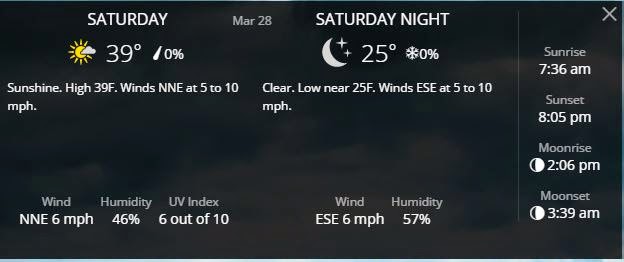
Saturday is the big day!  I wanted to walk this week but it's been so cold and rainy I just couldn't.  The weather for Saturday doesn't look promising temperature wise either.  Benny's been sick so I'm not asking him to sit out in the cold but maybe Austin will be there to cheer me on.  Nobody's contacted me yet so I guess I'm supposed to be there about 8:30....

Weather.com's Forecast


GoReIn2015 Q1 Update

I listed my goals for 2015 in the last post of 2014.  It looks like I haven't made much progress this first quarter but I still have the rest of the year!

#9 I believe that improving my overall health and wellness includes testing my hormones.  My GYN doesn't seem to think that I have hormonal issues seeing that I have regular and "normal" menses.  Hormones are one area that can affect sleep and none of the doctors I saw and ran the sleep studies discussed this.  One of the BODYpeace babes suggested seeing a Functional Medicine doctor but they aren't fully covered by my insurance so that's not an option for me with our high deductible.  We'll see what happens at my annual visit on Tuesday.

#10 I've decided that BODYpeace is the primary theme of my personal development this year.  Before I started this journey I didn't care about my body or what I looked like.  Now that I've hit goal I'm struggling with acceptance, especially with the loose skin and lack of boobs (they just don't look like boobs anymore).  So I'm concentrating my efforts on this topic (BODYpeace not boobs in case you're confused LOL).

#11 I'm doing well on maintaining my weight.  I tend to step on the scale daily to see what it says before working out but forget what it says before I even leave for work.

How are you doing on your goals for the year?


Linking up with
Weigh In Wednesday

Femme Fitale Fit Club